Sugaring vs. Waxing: What's the Difference, and Which Wins?
Sugaring vs. waxing at a glance
- Both methods remove hair from the root and typically offer a similar smoothness window when paired with thoughtful aftercare.
- The most meaningful difference is technique. Sugaring is generally removed with hair growth, while soft wax is removed against it.
- There is no universal winner. Skin preferences, hair texture, technician skill, and the product used should guide your choice.
If you've been researching hair removal, you've probably bumped into sugaring — often pitched as the "natural," gentler cousin of waxing. So what's the actual difference, and is one really better than the other? The honest answer is that they're more alike than the marketing on either side suggests, with a few real distinctions that might tip the choice for your skin and hair. Let's break it down clearly.
We've been waxing Utah since 2007, so yes, we have a horse in this race — but we'll give you the fair, accurate comparison, including where sugaring genuinely shines.
The big-picture similarity
First, the most important thing: both sugaring and waxing remove hair from the root. That's what sets them apart from shaving and makes both last far longer — typically around three to four weeks — with regrowth that comes in finer over time. Both also exfoliate the skin as they remove hair, and both get easier and more comfortable the more consistently you do them. So at the level that matters most — long-lasting, root-level removal — they're in the same category.
The differences are in the how.
What's actually in each
Sugaring paste is made from just three simple ingredients: sugar, lemon (juice), and water, heated into a sticky, candy-like consistency. It's warmed to roughly body temperature — warm, not hot. Its appeal for many people is that short, transparent ingredient list, which suits those who prefer a more natural product or who react to additives.
Wax comes in two forms. Hard wax is typically made from ingredients like beeswax, resin, and oils, and is removed after it cools and hardens, without strips. Soft wax is made with rosin, oils, and other additives and is removed with cloth or paper strips. (At Wax Me Too, we use a fragrance-free honey soft wax — more on the fragrance-free part below.)
So one real distinction: sugaring's ingredient list is shorter and, for some sensitive-skin clients, that simplicity is the draw.
The technique difference (this is the key one)
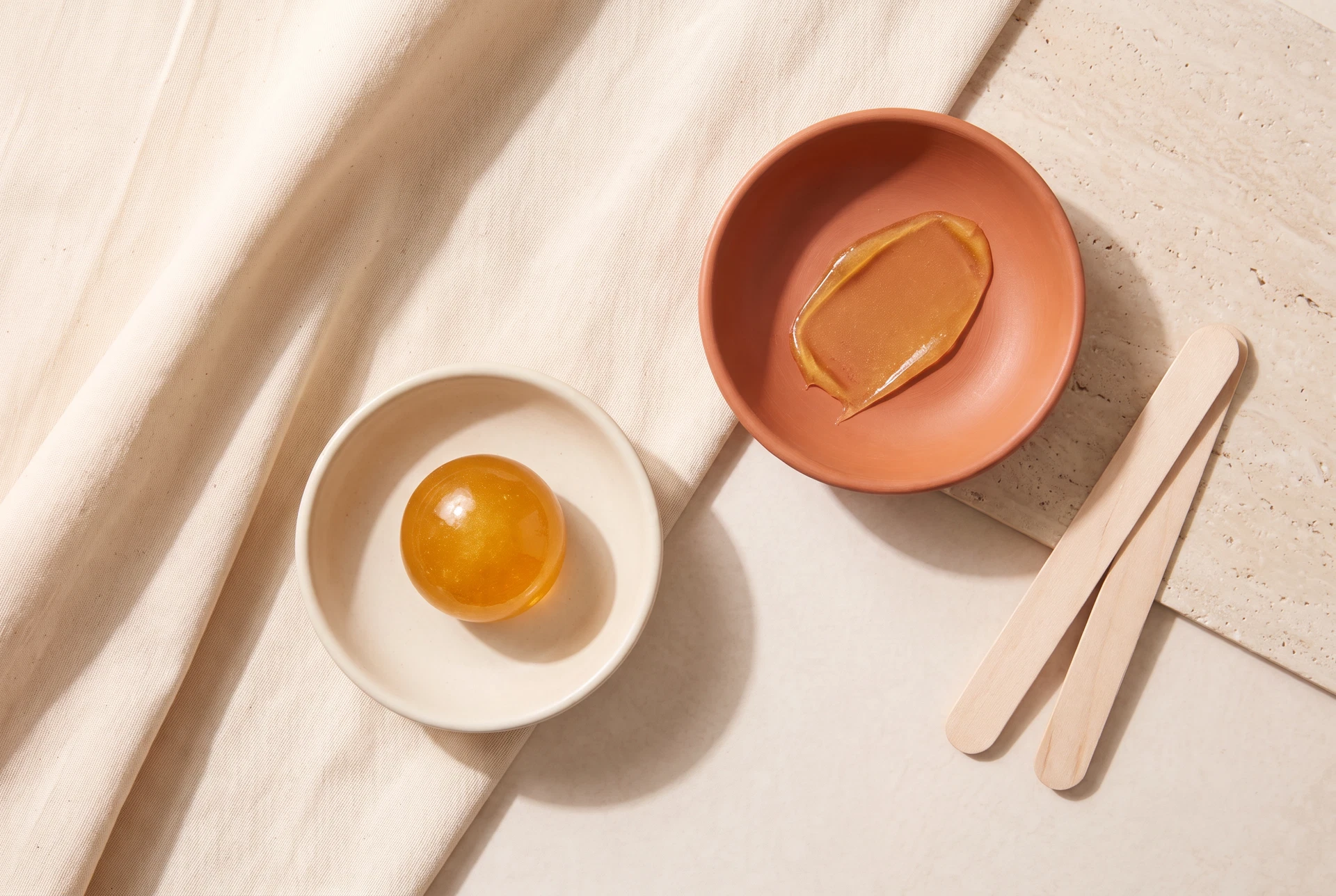
The most meaningful technical difference is the direction of removal, and it explains most of the claims you'll hear:
- Sugaring: the paste is applied against the direction of hair growth and then removed in the same direction the hair grows.
- Waxing: the wax is applied in the direction of hair growth and removed against it.
Because sugaring pulls the hair out in the same direction it grows, proponents argue it causes less breakage and can feel a bit gentler. Waxing's against-the-grain removal is a quick, clean pull, but it can occasionally break a hair rather than removing it whole. There's a real mechanism behind the "sugaring is gentle" claim — though, as we'll see, the practical difference is smaller than the marketing implies.
A couple of other technique notes: sugar paste doesn't adhere to live skin the way wax does — it sticks mainly to the hair and dead skin — so it can be reapplied over the same area several times and tends to have simpler cleanup (it rinses with water). Waxing typically removes a section in a single pull per application, which can make it faster, especially over larger areas.
Pain: the honest answer
You'll see sugaring marketed as "less painful." The truthful version is more nuanced: pain is highly subjective, and the difference is smaller than the claims suggest.
Some people do find sugaring more comfortable, thanks to the with-the-grain removal and the lower, body-temperature warmth. But sugaring isn't painless — you're still pulling hair from the root — and because the paste is applied against the grain and often removed in several passes per area, some people find the overall experience drags on longer than a quick wax pull. Meanwhile, plenty of people find a skilled, fast wax perfectly tolerable.
The most accurate takeaway: hair type, where you are in your cycle, the area being treated, and especially the skill of your technician matter more to your comfort than which method you choose. A great waxer will be more comfortable than a mediocre sugarist, and vice versa.
Ingrown hairs
Both methods, done well and paired with good aftercare, help keep ingrowns down — because both remove hair from the root and exfoliate. Sugaring proponents argue the with-the-grain removal causes less breakage and therefore fewer ingrowns, and there's a reasonable logic to that. But the bigger picture, echoed by balanced practitioners, is that prep, technique, and aftercare matter more than the method itself. Whether you sugar or wax, the same routine prevents ingrowns: exfoliate two to three times a week (starting a few days after), moisturize daily, wear loose clothing, and don't shave in between.
Coarse hair and effectiveness
One genuine practical difference: waxing tends to handle very coarse, thick hair especially well, gripping and removing it cleanly in one pull. Sugaring can absolutely remove coarse hair too, but some find it takes more passes or more consistency to get there. If you have thick, stubborn hair — common in the bikini area — waxing's decisive pull is often the more efficient route. (That said, "sugaring doesn't work on coarse hair" is an overstatement; with an experienced technician and consistency, it can.)
How long results last
Effectively a tie. Both sugaring and waxing keep you smooth for about three to four weeks on average, depending on your individual hair growth and how dark and coarse your hair is. With either method, staying on a regular schedule leads to finer, sparser regrowth over time. So if longevity is your deciding factor, it won't decide much — they're comparable.
A safety note that applies to both
One important thing that's the same for both methods: if you use topical retinoids, pause them on the area beforehand, and if you've taken isotretinoin (Accutane), you should avoid both sugaring and waxing during treatment and for about six months after your last dose, because the skin is too fragile and prone to tearing. Always tell your technician about medications and skin conditions, whichever method you choose.
What an appointment is like (for each)
The experiences are more similar than different. For both, you'll come in with clean, dry skin (no lotions or oils that day), your technician will take you to a private room, and you'll be guided into position for the area being treated. Hair should be about a quarter inch long so there's something to grip.
For waxing, the wax is applied in a thin layer in the direction of growth, a strip is pressed on (for soft wax), and it's removed with a quick pull against the grain — section by section, efficiently. For sugaring, the paste is applied against the grain and flicked off in the direction of growth, often with several passes over the same area. Both finish with soothing of the skin, and both leave you with some temporary redness that fades within hours to a day. Aftercare is identical for both: skip heat, heavy sweat, swimming, and sun for 24 to 48 hours, wear loose clothing, and start gentle exfoliation a few days later.
The "natural" and eco angle
One reason sugaring has a devoted following is its simplicity and environmental footprint: a three-ingredient paste of sugar, lemon, and water, with no strips, that rinses away with water. If using the most minimal, natural product possible is important to you, that's a genuine point in sugaring's favor. It's worth noting you can get much of the same skin-friendliness from waxing by choosing a studio that uses a clean, fragrance-free wax — fragrance is the additive most likely to irritate, and removing it closes much of the gap.
Common questions
Is sugaring really less painful? Sometimes, for some people — but pain is subjective and the difference is modest. Technique and your hair type matter more than the method.
Which is better for ingrowns? Both help when paired with good aftercare. The method matters less than exfoliating regularly, moisturizing, and not shaving in between.
Can I switch between them? Yes. Many people do, and you can move between sugaring and waxing without any problem. Try both and see what your skin prefers.
Does either work on short hair? Both need roughly a quarter inch of growth; sugaring can sometimes grab slightly shorter hair, but a quarter inch is the safe target for both.
Which lasts longer? Effectively a tie — about three to four weeks for both, with finer regrowth over time if you stay consistent.
Is one cheaper or easier to find? Pricing for the two is broadly comparable and varies by studio and area. Waxing is more widely available, so you'll generally find more studios and more experienced technicians offering it, which matters because skill is the biggest factor in your experience. Sugaring is more specialized; if you want it, look specifically for a studio and technician experienced in it.
Can I do either at home? Both have at-home versions, but the bikini area in particular is genuinely hard to do well yourself — awkward angles, technique, and hygiene all work against you. A professional, for either method, is far more comfortable and complete, especially for a Brazilian.
Three scenarios to help you decide
Sometimes it's easiest to see yourself in an example:
You have very sensitive skin and prefer minimal-ingredient products. Sugaring's three-ingredient, lower-heat paste is appealing here — though a fragrance-free wax is also gentle, so try both and see which your skin prefers. Either way, tell your technician about your sensitivity so they can take extra care.
You have coarse, thick hair (especially bikini-area) and want it done efficiently. Waxing's decisive single-pull removal tends to handle stubborn hair cleanly and quickly. Sugaring can do it too, but may take more passes. If speed and a no-fuss coarse-hair removal matter most, waxing is often the practical pick.
You're brand new and just want the best experience. Honestly, choose based on the technician, not the method. A highly skilled, well-reviewed esthetician — whether they sugar or wax — will give you a better experience than a mediocre practitioner of your "preferred" method. Read reviews, ask questions, and prioritize skill and hygiene over the label on the jar.
The throughline across all three: there's no method that's universally right for everyone. Match the method to your skin and hair, then prioritize the skill of the person doing it.
So which wins?
Here's the honest verdict: for most people, the choice comes down to preference, not a clear winner.
- Sugaring may suit you if you prefer a minimal, natural ingredient list, you have very sensitive skin that reacts to wax additives, or you simply like the with-the-grain technique.
- Waxing may suit you if you want efficient removal — especially on coarse hair or larger areas — a quick single-pull experience, and the widest availability of skilled technicians and services.
Both are legitimate, effective, root-level methods. The single biggest factor in how happy you'll be isn't the method — it's the skill of the person doing it and the aftercare routine you keep.
Why we choose wax — and make it gentle
We've built our craft around waxing since 2007 because, in skilled hands, it's fast, effective on every hair type, and delivers complete, long-lasting removal — and we finish every service with tweezers so there's no hair left behind. The piece of the "natural/gentle" conversation we took to heart is irritation: that's why we use a fragrance-free honey soft wax, since fragrance is one of the more common skin irritants. The result is a gentle, efficient wax that suits sensitive skin while still handling coarse hair with one clean pull.
If you've only ever tried a harsh or heavily fragranced wax elsewhere, a gentle, expert wax may surprise you. The discomfort and irritation people blame on "waxing" is very often really about an overheated or fragranced product and rushed technique — none of which is inherent to the method. With the right wax and an experienced hand, the gap between "natural" sugaring and a quality wax narrows to a matter of personal preference.
Want to feel the difference a gentle wax makes? New clients can ask about our first-time Brazilian wax special when booking. Book online at waxmetoo.com.
Find your nearest Wax Me Too studio — six women-owned waxing studios across Utah: Draper · Salt Lake City · South Jordan · Layton · Orem · St. George
Related reading
- Waxing vs. Shaving: Which Is Actually Better?
- Soft Wax vs. Hard Wax: Why We Use Fragrance-Free Honey Soft Wax
- Why You Get Ingrown Hairs After Waxing — and How to Stop Them
Sources & references
- Cleveland Clinic — What Is Sugaring? Pros and Cons of This Hair Removal Option (sugar/lemon/water paste; direction of removal; multiple passes; results last ~3 weeks): https://health.clevelandclinic.org/what-is-sugaring
- Healthline — Sugaring vs. Waxing (ingredients and direction of application/removal; wax composition; results last about the same; aftercare): https://www.healthline.com/health/beauty-skin-care/sugaring-vs-waxing
- Baylor College of Medicine — Laser, wax or sugar? (both remove from the root; pain is variable; avoid sugaring for six months after isotretinoin): https://blogs.bcm.edu/2024/06/10/laser-wax-or-sugar-choosing-the-right-hair-removal-option/
- American Academy of Dermatology — Isotretinoin: FAQs (avoid waxing during isotretinoin treatment and for 6 months after): https://www.aad.org/public/diseases/acne/derm-treat/isotretinoin/faqs
This article is general education, not medical advice. If you take prescription medication or have a skin condition, check with your healthcare provider and tell your technician before your appointment.